
You Paid the Tariffs. Now It May Be Time to Recover Them.
Your Business May Be Owed an IEEPA Tariff Refund
If your business was the Importer of Record and paid tariffs under the International Emergency Economic Powers Act (IEEPA), often listed as Chapter 99, fentanyl, reciprocal, baseline or emergency tariffs, you may be entitled to a significant refund.
However, getting your money back isn't automatic. Filing errors, calculation mismatches and missed phase requirements are currently causing stalled or reduced payouts across the market.
Anchor Accounting Services eliminates that risk. Powered by our end-to-end recovery technology, we handle every step, from precise phase-aware filings to active claim monitoring and final refund processing. We manage the full life cycle across customs, treasury and tax so you receive 100% of what you're owed.
Current status: CAPE Phase 1 & Phase 2 are LIVE
Program Update (Summer 2026):
U.S. Customs and Border Protection (CBP) has officially launched Phase 1 and Phase 2 of the CAPE refund system inside ACE.

Phase 1 & Phase 2 Active: Processing is now open for eligible unliquidated entries, recent liquidation windows and an estimated 2.8 million entries flagged for reconciliation (unlocking an additional $28.7 billion recovery pool).
Phase 3 Rolling Out in August: The next major phase, targeting finalized and contested entries, is slated to open in August 2026.
How Anchor Helps: Anchor Accounting Services is processing, filing and monitoring claims actively across both live phases right now. Our end-to-end platform ensures your historical trade data is formatted perfectly to meet strict CBP guidelines, protecting your claims against permanent Phase 2 lockouts before final reconciliation paperwork is transmitted.

Built for Small and Midsized Importers

Phase-Aware Claim Management

End-to-End Recovery Coordination

Capital Access Options Where Appropriate
330k+ importers of record potentially affected
53M+ customs entries subject to IEEPA tariffs
$166B+ in tariffs collected, with additional refund value potentially available through statutory interest
A Major Recovery Opportunity is Open for Impacted U.S. Importers
Many businesses paid substantial tariffs without realizing that those amounts might one day become part of a recovery opportunity. For businesses impacted by the IEEPA tariff program, this may represent meaningful capital that could potentially be returned to the business.
But this is not a simple refund exercise. It may require historical record review, customs documentation, claim support, ongoing follow-up and careful coordination across legal, treasury and tax matters.
For many businesses, the opportunity is real. The process is just too burdensome to manage on your own.
The Opportunity is Real. Seize it.
Recovering tariffs may involve far more than submitting a request and waiting for payment. Businesses may need to identify eligible entries, organize fragmented records, prepare the right filing path for the right phase, and continue managing the claim after submission.
For many small and midsized importers, that level of coordination is difficult to manage internally.
Many businesses do not realize they qualify
Tariffs were often buried in landed costs, broker statements and internal accounting records, masking the full extent of your exposure.

One recovery now requires multiple phase-aware filings
With Phase 1 and Phase 2 live and Phase 3 launching in August, businesses must manage sequential submissions rather than a single filing.

Filing errors are causing marketwide refund delays
Inaccurate duty calculations or mismatched Importer of Record (IOR) details are causing widespread rejections. Precision-built filings are required to ensure you receive 100% of what you are owed.

Filing is only the first step; monitoring is critical
A claim isn't complete when it's submitted; it's complete when the refund lands in your bank account. Active monitoring is required to resolve government inquiries before deadlines expire.

Do not let Complexity Force You to give Away Your Recovery
If your business may be entitled to a refund, the goal should not be to walk away from the opportunity just because the process feels overwhelming.
It also should not mean giving up a large share of what may be owed simply because another party is willing to move faster or make the situation sound easier than it is. Some businesses may feel pressured to accept heavily discounted arrangements just to avoid the burden, only to lose a substantial portion of the value before tax consequences are even considered.
Anchor Accounting Services is built to offer a more practical path. We help businesses pursue recovery with structured, end-to-end support that simplifies the process, preserves more of the potential value and reduces the burden on internal teams.
Whether your goal is to recover what may be owed, simplify a complex process, or explore capital options to help you access value sooner, Anchor and its partners help manage the path from review through resolution.
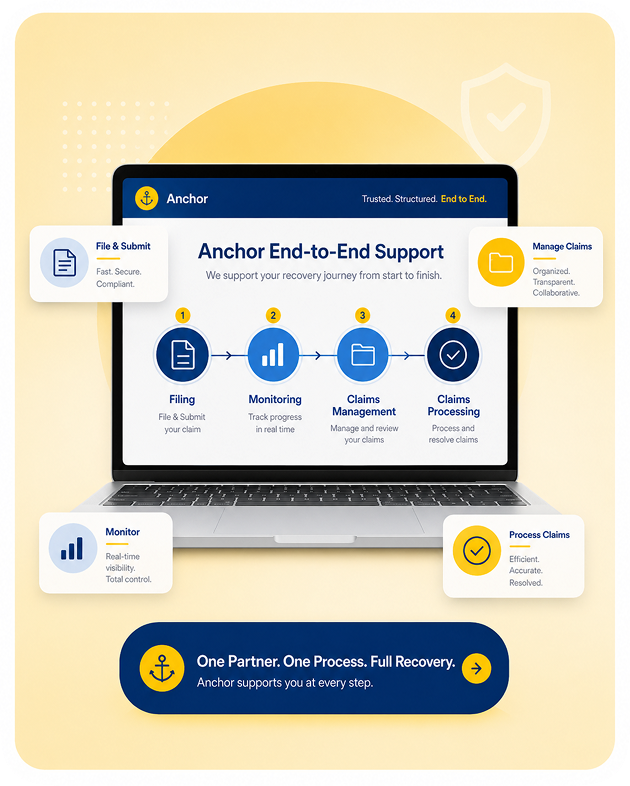
Anchor Accounting Services: The only end-to-end technology for filing, monitoring and processing
Anchor Accounting Services is purpose-built for businesses that lack in-house trade, legal and tax compliance infrastructure. While other providers only handle basic paperwork, Anchor is the only partner with the proprietary technology to handle filing, live claim monitoring and final refund processing under one roof.
Instead of forcing your team to manage disconnected brokers, law firms and portal status updates, Anchor centralizes your entire recovery lifecycle into a single managed service.
.png)
Tariff Exposure Discovery
We analyze Form 7501 entry summaries, ACE data, broker feeds and duty history to map 100% of your recoverable exposure.

Claim Architecture & Phase Mapping
We organize your entries by CAPE Phase (Phase 1, Phase 2 or Phase 3) to ensure every record is filed under the correct operational window.

CPA-Backed Precision & Documentation
We scrub and validate your data down to the line item, eliminating the formatting errors that cause government rejections and payout delays.
.png)
Active Claim Servicing & Live Monitoring
We don't just file and walk away. Our technology monitors your claim status inside ACE actively, resolves CBP requests for information and keeps your file moving through processing.

Payout, Offset & Refund Processing
We track your refund from government authorization to final deposit, managing ACH configurations, reviewing offset risks and reconciling received funds against original entries.
.png)
Tax & Capital Coordination
We help your finance team account for recovered principal and statutory interest while exploring optional advance liquidity options where appropriate.
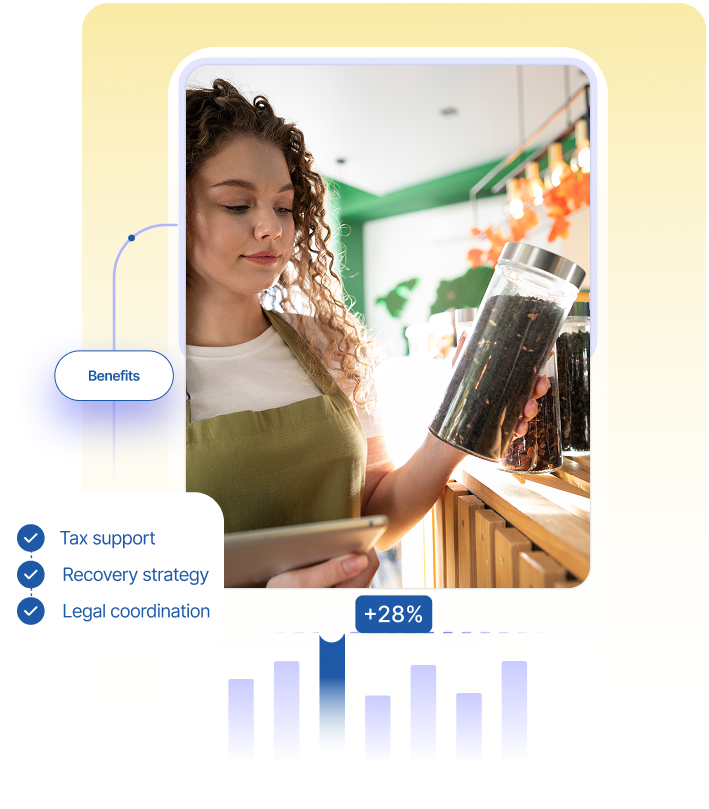
Why importers prefer Anchor’s integrated technology model
Most businesses cannot afford a fragmented approach to tariff recovery.
Law firms may handle litigation but lack data processing tech. Customs brokers are often unwilling to take on historical legal liability. Traditional CPA firms lack trade recovery infrastructure. Litigation funders offer cash but no claim management.
Anchor brings strategy, precise filing, active claim monitoring, refund processing and tax support together into a single, seamless platform.
One coordinated process Zero Filing AnxietyEnd-to-End Tech PlatformFull Payout VisibilityBuilt for Importer ComplexityHow The Process Works
This is not a self-service tool or a basic submission form. Anchor provides a fully managed, step-by-step recovery process powered by dedicated trade technology.
Step 1 — Submit Your Review Request
Provide a few basic business details so our data team can assess your import profile.
Step 2 — Personalized Consultation
We meet one-on-one to review your historical imports, broker relationships and tariff exposure across live CAPE phases.
Step 3 — Data Scrubbing & Claim Architecture
Our system reviews your ACE data, 7501s, and entry summaries to identify every eligible entry, eliminate formatting errors and build an audit-ready claim file.
Step 4 — Phase-Aware Filing & Submission
We execute your filings across live Phase 1 and Phase 2 pathways and prepare your remaining entries for the Phase 3 rollout in August.
Step 5 — Active Monitoring & Refund Processing
Our technology tracks your claim through government review, resolves portal discrepancies, verifies ACH payout release and reconciles incoming funds back to your general ledger.
Begin Step 1: Submit Your Review Request
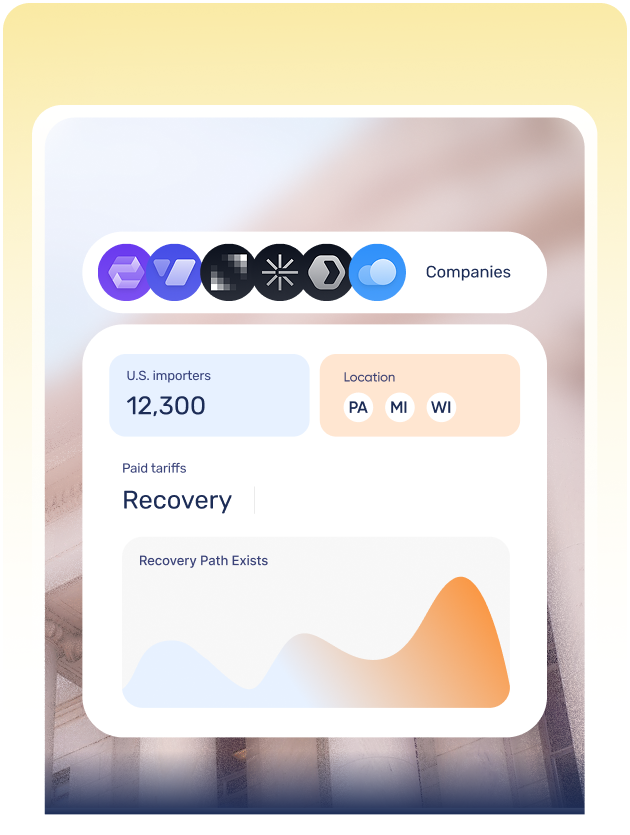
Who this may be right for
This service is engineered specifically for U.S. Importers of Record who paid IEEPA tariffs and need an error-free, stress-free path to recovering their capital.
It is ideal for midmarket and growing businesses that require enterprise-grade trade infrastructure without hiring dedicated in-house compliance teams.
Examples include:
Manufacturers importing raw materials, metals or componentsDistributors, wholesalers and retailers importing finished goodsE-commerce brands selling imported consumer merchandiseSpecialty importers in apparel, home goods, electronics, machinery, food products and outdoor gearImporters with multiple brokers needing a centralized system of record to reconstruct historical entry dataFinance leaders requiring full audit defense, controllership review and tax coordinationRecovered capital belongs back in your business
Tariff recovery is more than correcting past government overreach; it is about restoring vital liquidity to drive your future growth.
Unlocking your trapped tariff capital allows you to strengthen balance sheets, offset rising operational costs and reinvest without taking on new debt.
Improve Liquidity
Inject recoverable cash directly back into working capital.
Fund growth
Reinvest in equipment, inventory, technology, expansion or key talent.
Eliminate administrative burden
Achieve full recovery without distracting your internal accounting or operations teams.

What businesses should understand about the Recovery Process
The IEEPA recovery environment is fast-moving and operationally strict. With Phase 1 and Phase 2 live, and Phase 3 scheduled for August, success requires strict compliance with evolving federal rules.
Inaccurate filings, missed reconciliation deadlines or improper documentation can permanently lock your entries out of eligible refund windows. Partnering with an end-to-end management provider ensures your claim is protected from submission through to final payout.
Critical Areas Anchor Manages for You:
Comprehensive entry identification and data scrubbingPhase 1, Phase 2 and upcoming Phase 3 submission mappingProtection against permanent post-reconciliation lockoutsContinuous claim tracking, discrepancy resolution and portal monitoringACH payment readiness, offset verification and financial reconciliationTax accounting and reporting for recovered principal and statutory interestStay current as the process evolves
IEEPA guidance, CAPE phases, and recovery mechanics are still evolving. Visit our IEEPA Resource Hub for current updates, regulatory developments, and practical guidance that may affect how businesses approach recovery.
Visit the IEEPA Resource HubGet a Personalized Tariff Recovery Review
If your business may have been impacted by the IEEPA tariff program, Anchor can help you understand what the opportunity may look like, what records may be involved, and how the recovery path may need to be managed under the current CAPE environment.
Complete the form, and our team will reach out to schedule a personalized interview about your situation.
A recovery review helps your business understand potential exposure, likely claim complexity, the records involved, and what it may take to move from possible eligibility to actual recovery.


Know a Business That May Have Paid IEEPA Tariffs?
You do not need to be the importer to help create a recovery opportunity.
Through MyGig, professionals, advisors, brokers, and well-connected business leaders can refer qualified U.S. importers to Anchor Accounting Services and may earn commissions on eligible opportunities.
Your role is simply to make the introduction. Anchor handles the complex work that follows, including record reconstruction, exposure analysis, phase-aware filing, CAPE submission, claim monitoring, and recovery coordination.

Why Refer Through


A Clear Business Need
Many importers know they paid tariffs but do not have the time, records, or internal expertise needed to pursue recovery.
A Managed Referral Path
MyGig provides the tools and structured process for introducing qualified businesses and tracking your referral.
Anchor Handles the Recovery
After the introduction, Anchor works directly with the importer to review the opportunity and manage the recovery lifecycle.
Potential Commission Income
MyGig Certified Resellers may earn on qualified IEEPA recovery opportunities generated through their referral relationships.
Whether you work with manufacturers, retailers, wholesalers, e-commerce brands, private equity firms, customs brokers, or financial leaders, your network may include businesses with meaningful capital tied up in IEEPA tariffs.

